
-
-34%
 Regular price $39.50Regular price
$60.00-34%Sale price $39.50
Lockout tagout lock boxes for safe group lockout procedures in the workplace
Lockout tagout lock boxes play a central role in group lockout procedures, where multiple authorized workers must safely isolate hazardous energy sources before maintenance or servicing begins. Instead of relying on a single individual to control access to lockout keys, these devices provide a secure, centralized system that ensures all energy isolation points remain locked until every worker has completed their task. This significantly reduces the risk of accidental equipment start-up and supports consistent, verifiable lockout practices across teams.
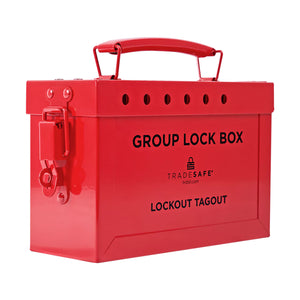
TRADESAFE group lockout boxes are designed to meet the demands of industrial environments where safety, coordination, and compliance are critical. By allowing each authorized employee to apply their personal padlock to a shared lock box, these solutions ensure that access to keys is restricted until all locks are removed. This structured approach strengthens accountability, improves communication between teams, and helps facilities maintain compliance with OSHA requirements for hazardous energy control.
Group lockout boxes for controlling hazardous energy during maintenance operations
In real-world maintenance environments, group lockout boxes act as a central control point for managing shared lockout procedures and maintaining strict energy isolation protocols. They are especially valuable in situations where multiple workers or teams must coordinate their efforts across complex systems.
They are commonly used in scenarios such as:
-
group lockout during equipment maintenance and servicing
-
shared control of keys for energy isolation points
-
coordination of multiple authorized workers
-
use in electrical, mechanical, and process systems
-
application in complex or high-risk maintenance tasks
By consolidating keys within a secure enclosure, group lockout boxes eliminate uncertainty around access to hazardous energy sources. This not only improves operational safety but also reduces the risk of miscommunication and human error, which are common factors in workplace incidents. As a result, these devices become a critical component of any facility focused on maintaining safe and efficient maintenance operations.
Group lockout tagout boxes for team-based safety and compliance programs
Group lockout tagout boxes are built to support structured, team-based safety programs where multiple workers must follow strict lockout procedures. Their design ensures that each authorized employee has direct control over their safety, while still maintaining a coordinated system for managing hazardous energy.
Key features that define effective group lockout boxes include:
-
multiple lock points for authorized personnel
-
secure key storage during lockout procedures
-
durable construction for industrial environments
-
high-visibility design for easy identification
-
compatibility with padlocks and lockout tagout systems
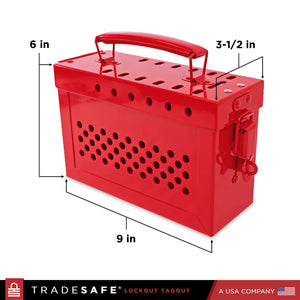
These features allow facilities to standardize lockout procedures while improving both safety and efficiency. Industrial-grade lock boxes, often constructed from powder-coated steel or other durable materials, are built to withstand demanding conditions while maintaining secure key containment. Additional elements such as hinged covers, key drop slots, and visibility openings further enhance usability, ensuring that workers can easily verify lockout status without compromising safety.
LOTO lock box solutions for secure key control and workplace safety
LOTO lock box solutions are essential for maintaining proper control of hazardous energy during group maintenance activities. By introducing a physical barrier between workers and energy isolation keys, these devices ensure that no equipment can be re-energized until every authorized individual has completed their work and removed their lock. This structured process reinforces procedural discipline and minimizes the risk of serious workplace incidents.
Their role is closely aligned with OSHA 29 CFR 1910.147, which requires employers to implement effective lockout tagout procedures for controlling hazardous energy. While lock boxes are one component of a broader safety program, they play a critical role in improving accountability, coordination, and compliance in multi-worker environments. Without proper group lockout solutions, facilities face increased risks of accidental startup, inconsistent procedures, and regulatory violations.
Explore this collection to find high-quality lockout tagout lock boxes designed for reliable performance in demanding industrial settings. Choose durable, compliant solutions that support safe group lockout procedures, improve team coordination, and help maintain full control over hazardous energy in your workplace.