
-
-47%
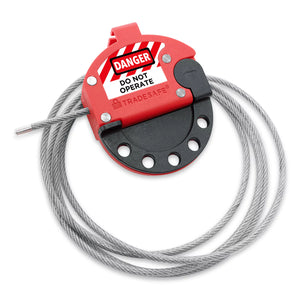
 Regular price $18.95Regular price
$36.00-47%Sale price $18.95 -
-54%

 Regular price $29.90Regular price
$65.00-54%Sale price $29.90


Cable Lockout Options for Flexible Industrial Energy Isolation
Cable lockout products provide flexible control for compatible energy isolation points that fixed-size or rigid devices may not address efficiently. During maintenance, servicing, inspection, or controlled shutdowns, the cable can route through or around compatible breakers, valves, machinery, panels, and other difficult-to-access lockout points. TRADESAFE offers 6 ft and 10 ft configurations for different routing distances and equipment layouts.
An adjustable cable lockout uses a flexible cable threaded through one or multiple compatible isolation points and secured at the device body before safety padlocks are attached. This design supports irregular shapes, separated points, and multi-point setups while allowing buyers to select the reach and cable management appropriate for the application. Neither cable length is universally better, and each intended use should be checked against the product specifications.
Cable Lockout Devices for Valves, Breakers, and Machinery
Industrial buyers should compare construction, cable specifications, routing capability, lock capacity, and application compatibility. The collection includes verified specifications and purchasing considerations that help distinguish the two cable-length options.
Compare these cable lockout device specifications:
- cable length
- cable diameter
- multi-stranded stainless steel cable construction
- PVC or other protective cable coating where specified
- UV-protected coating where confirmed by the product specifications
- flexible cable routing capability
- rugged nylon or other device body material
- brass or other reinforced cable end used for threading
- number of integrated padlock positions
- maximum number of LOTO padlocks supported
- compatible safety padlock shackle diameter
- warning label and identification or marking area
- overall device dimensions where relevant
- quantity of devices included per pack
Cable lockout requirements depend on equipment layout, the number and spacing of isolation points, required reach, and padlock needs. Buyers should compare each model with the intended application rather than assume every device provides the same working length, routing capacity, or compatibility.
Adjustable Cable Lockout for Different Routing and Cable Length Requirements
The 6 ft cable can provide more convenient cable management where compatible isolation points are relatively close together. The 10 ft cable adds reach for points that are more widely spaced, numerous, or difficult to access. The two models otherwise share confirmed core construction and padlock capacity, making cable length the key selection difference.
Evaluate the routing requirements for the intended setup:
- total cable length
- distance between compatible isolation points
- number of lockout points that may need to be routed together
- equipment size and physical layout
- access around valves, breakers, machinery, panels, or other equipment
- amount of cable routing required around equipment
- cable diameter and flexibility
- cable coating and construction
- integrated padlock positions
- maximum padlock capacity
- compatible padlock shackle dimensions
- threading and cable-end design
- facility-specific maintenance and servicing requirements
Choose cable length according to the equipment layout and required routing distance. A longer cable provides more reach but is not automatically more suitable, while a shorter configuration can reduce excess cable where less distance must be covered. Facilities should confirm compatibility and follow their written energy control procedures.
Adjustable Cable Lockout Devices for Industrial LOTO Programs
Adjustable cable lockout devices can support maintenance and lockout/tagout programs when conventional fixed-size devices do not provide enough routing flexibility. They may be relevant in manufacturing plants, processing environments, utilities, warehouses, workshops, commercial facilities, mechanical rooms, electrical maintenance departments, and other workplaces with compatible valves, breakers, machinery, panels, or equipment.
Their flexible routing can help address irregular equipment layouts, hard-to-reach isolation points, and several compatible points within one lockout setup. Under OSHA 29 CFR 1910.147, these devices may support a facility’s broader hazardous energy control program, but they do not establish compliance by themselves or replace application-specific lockouts in every situation.
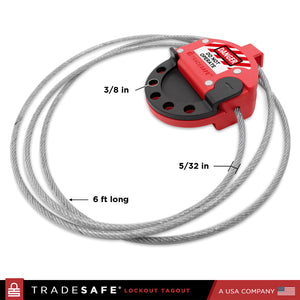
Browse the collection and compare adjustable cable lockout devices by 6 ft or 10 ft cable length, 5/32 in diameter, equipment layout, routing distance, PVC-coated stainless steel construction, nylon body, five-padlock capacity, and 3/8 in shackle limit. Review the individual specifications and select the configuration that fits your facility’s equipment, padlocks, and written lockout/tagout requirements.