
-
-70%

 Regular price $35.80Regular price
$120.00-70%Sale price $35.80 -
-64%

 Regular price $43.80Regular price
$120.00-64%Sale price $43.80 -
-49%

 Regular price $29.95Regular price
$59.00-49%Sale price $29.95 -
-49%

 Regular price $29.95Regular price
$59.00-49%Sale price $29.95 -
-49%
 Regular price $39.95Regular price
$79.00-49%Sale price $39.95 -
-49%
 Regular price $44.95Regular price
$89.00-49%Sale price $44.95


Push Button Lockout for OSHA-Compliant Equipment Safety
Push button lockout devices are used to secure control points such as emergency stops, start-stop buttons, and panel-mounted switches during maintenance and servicing. Instead of isolating the primary energy source, these devices focus on the point of operation, physically preventing button access and reducing the risk of accidental or unauthorized activation. In facilities where exposed controls are common, this added layer of protection helps close a gap that traditional lockout methods may not fully address.
For safety managers and maintenance teams, integrating push button lockouts into lockout/tagout procedures supports a more complete approach to hazardous energy control under OSHA 29 CFR 1910.147. TRADESAFE push button lockout devices are designed for this exact purpose, helping teams reinforce safe work practices while maintaining visibility of the secured control. These devices should be used as part of a broader energy control program, aligned with site-specific procedures, training, and compliance requirements.
Push Button Lockout Device for Hazardous Energy Control
In real-world industrial environments, push button lockout devices are applied directly to control panels, machinery interfaces, and electrical systems where exposed buttons present a risk during servicing.
Common safety applications include:
-
preventing accidental button activation
-
isolating control switches during maintenance
-
improving visibility of locked equipment
-
supporting lockout/tagout procedures
-
reducing risk of unexpected machine startup
By securing the control interface itself, these devices help ensure that even if upstream energy isolation is incomplete or bypassed, the equipment cannot be activated through normal operator controls. This is especially relevant in shared workspaces, multi-shift operations, or facilities with frequent maintenance activity, where consistent control over equipment startup is critical.
Push Button Lockout Cover for Safe Equipment Isolation
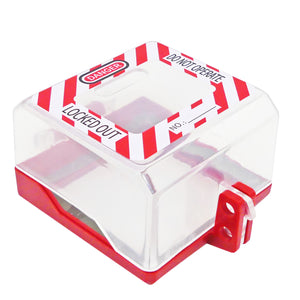
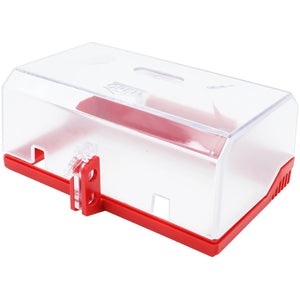
Push button lockout covers are engineered to provide a physical barrier over control devices while maintaining clear visibility of the underlying button or switch. This balance of protection and visibility is important for both safety enforcement and operational awareness, allowing teams to quickly identify which controls are locked out without removing the device.
Key design features of push button lockout covers include:
-
transparent covers for visual inspection
-
durable materials suited for industrial environments
-
compatibility with different button sizes and mounting configurations
-
simple installation using adhesive and secure locking mechanisms
-
designed for emergency stop buttons and control switches
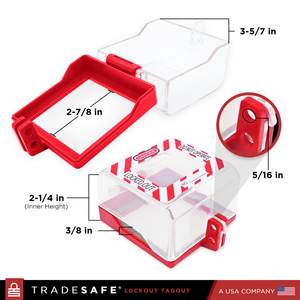
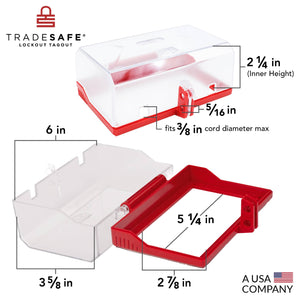
Material selection plays a central role in performance. Transparent polycarbonate construction offers impact and abrasion resistance, while ABS bases in box-type designs add structural stability. Size variations, from smaller round covers to larger box-style enclosures, allow buyers to match the device to specific control panel layouts, including applications where multiple buttons need to be enclosed within a single lockout point.
Emergency Stop Push Button Lockout for High-Risk Equipment
Emergency stop push buttons are among the most critical control points on industrial equipment, and they are often positioned in high-traffic or easily accessible areas. During maintenance or servicing, these controls can become a liability if left exposed, as accidental contact or intentional activation can lead to unexpected machine movement or system startup. Using a dedicated emergency stop push button lockout helps secure these high-risk controls by fully enclosing the button and preventing access until work is done.
This is particularly important in environments with heavy machinery, automated systems, or energized equipment where unintended activation could result in serious injury or equipment damage. For facilities focused on improving safety performance and maintaining compliance with OSHA lockout/tagout requirements, these devices provide a practical, targeted solution.
Explore the full collection to find push button lockout covers designed to match your equipment, control layouts, and safety procedures, and strengthen your overall hazardous energy control strategy.